



Welcome » Swiss ambulance outfitting
Manufacturer of custom-built ambulances in Switzerland
Geneva-based ambulance manufacturer and outfitter PNX Rescue designs, converts, and delivers custom-built medical transport vehicles throughout Switzerland. Serving ambulance services, hospitals, clinics, medical transport companies, and local authorities, each vehicle is designed based on your specific needs, whether it's a complete build on a new chassis or the conversion of an existing vehicle in your fleet.
Our four founders have worked in pre-hospital care for over twenty years. This is what separates an ambulance layout designed by a design office from one conceived by people who have worked in the patient compartment, at night, under pressure. This difference is evident in the placement of storage, the height of a work surface, the routing of a cable.
Based in Switzerland and active throughout the country, PNX Rescue designs vehicles that comply with Swiss and European regulatory requirements, are ready to be put into service and are sized for intensive use.
The three ways to get your ambulance
Depending on your budget, schedule, and the condition of your fleet, three options are available. We will review these options with you before providing a quote, as the best choice depends primarily on the intended use and the target operating period.
Complete construction on a new chassis
We start with a new chassis, most often a Mercedes-Benz Sprinter, and build the entire medical unit from scratch. This approach offers the greatest freedom: layout, dimensions, electrical systems, and equipment are defined in collaboration with you, free from any inherited constraints. It also requires the longest lead time and the highest investment. It is the ideal solution for long-term deployment, for a Class C vehicle, or when your missions deviate from standard configurations.
The transformation of a vehicle you own
Do you have an aging van, service vehicle, or ambulance? Ambulance conversion involves reusing the existing chassis to install a new patient compartment or upgrading the existing layout to meet current standards. Since the chassis is already fully depreciated, the investment and timeframe are significantly reduced.
This approach, however, requires a preliminary assessment. The condition of the vehicle body, mileage, remaining payload, and available electrical capacity determine what is advisable to install. We conduct this assessment before providing a quote.
The refurbished used ambulance
We select and refurbish used ambulances with the same high standards as our new vehicles: every component is inspected, modernized, or replaced. This is the fastest solution when a vehicle needs to be put into service without waiting for a new one to be manufactured, or to supplement a fleet on a budget. Discover our range of...’used ambulance in Switzerland.
Our process, from study to delivery
A custom ambulance project requires planning. Here is the complete, step-by-step process, including the factors that determine the duration of each step. A firm schedule will be provided with the quote once the chassis and configuration are finalized.
- Analysis of needs and missions. We start with your actual interventions: primary, secondary, specialized, neonatal transport, bariatric. The type of mission determines the vehicle category and most of the subsequent decisions. This is the shortest step in terms of time, and the most crucial for the outcome.
- Ergonomic study of the cell. Positioning the stretcher, accessing equipment, positioning the attendant's seat, and moving around the patient. Its duration depends on the number of trips required with your teams: the earlier your paramedics are involved, the faster it will be.
- Chassis selection. Wheelbase, roof height, engine, payload, transmission. This is where the overall delivery time is most of the factor, as it depends on manufacturer availability. Our partnership with the Mercedes-Benz Pierre Steulet SA network gives us direct access to available configurations and post-delivery technical support.
- Design and validation of the plan. You will receive the layout plans for approval before any manufacturing begins. No production will start without your written agreement: this is your guarantee that the delivered vehicle will correspond to what you have approved.
- Manufacturing of the sanitary unit. Furniture, coverings, certified fixings, ventilation, sound and thermal insulation. The duration varies depending on whether it is a box or a van conversion.
- Electrical and medical integration. Backup power, medical outlets, treatment lighting, oxygen therapy, medical device mounts, communication systems. This is the most critical step: poorly designed electrical integration will have consequences throughout the vehicle's lifetime.
- Approval. Preparation of the technical file and submission to the expert assessment. This step depends in part on the deadlines of the motor vehicle department in your canton, which we integrate into the schedule from the outset.
- Final quality control. Point-by-point verification of fixings, circuits and equipment, then road tests before delivery.
- Team training and delivery. Take possession of the vehicle with your paramedics, and receive the technical documentation and certificates. A well-designed vehicle that is poorly handled loses some of its value: this step is not a mere formality.
A transformation or a reconditioning follows the same process, without the steps of chassis selection and complete cell manufacturing, which significantly shortens the schedule.
Box van or van: how to choose
This is the first major decision in a custom ambulance project, and the one that commits you the longest. Both solutions are valid; they simply address different constraints.
| Criteria | Subwoofer | Converted van |
|---|---|---|
| Usable cell volume | Upper, vertical walls usable along their entire height | Constrained by the shape of the original crate |
| Working height | Defined at the design stage, independent of the carrier | Depends on the model and the chosen roof height |
| Weight | Higher, to be included in the payload calculation | Lighter weight, better preserved payload |
| Initial investment | Higher | More accessible |
| Reuse on a new chassis | Possible: the cell is depositable and transferable | No: the modification remains linked to the vehicle |
| Manufacturing time | Longer | Shorter |
| Typical uses | Intensive operation, regularly renewed fleet, type C vehicles | Medical transport, secondary interventions, controlled budget |
The decisive argument is often the transferability. A box body can be removed and reinstalled on a new chassis at the end of the vehicle's lifespan. Over a ten- to fifteen-year operation, this changes the economic equation, since you are only replacing the rolling chassis. Conversely, a converted van remains simpler, lighter, and more affordable when the vehicle is intended to be operated and then resold as a complete unit.
Discover our two solutions: the Rescube chamber and the’custom-built ambulance van. For needs that go beyond the scope of a standard ambulance, we also carry out... mobile hospitals and TPMR vehicles. We also offer the accessible transport rental in Switzerland for your occasional needs.
Compliance: EN 1789 standard
This is the first question an ambulance service asks, and it is legitimate: a non-compliant custom-made medical vehicle will not be approved.
The European standard IN 1789, The regulation, entitled "Medical Transport Vehicles and their Equipment", sets out the design, testing, performance and equipment requirements for road ambulances. It does not address registration or crew training, which fall under the jurisdiction of national and cantonal authorities.
It defines three levels of vehicles, in ascending order of carrying capacity:
- Types A1 and A2: patient transport ambulances. A1 for one patient, A2 for several. Intended for scheduled transport of patients whose condition does not require emergency care.
- Type B: Emergency care ambulance. Designed for patient transport, first aid and monitoring.
- Type C: Mobile intensive care unit. The highest level, for resuscitation and intensive monitoring during transport.
Each level imposes its own requirements for volume, anchoring, power supply, and onboard equipment. Determining the target category is therefore the very first step in a project: it dictates the choice of chassis and the entire layout. This is also the information a public buyer must finalize before drafting their specifications, and we will assist you with this from the very first discussion.Our vehicles are designed to meet the requirements applicable to their category, and the technical file necessary for the assessment is given to you upon delivery.
Our suppliers and partners
The reliability of an ambulance conversion depends as much on the workshop workmanship as on the quality of the installed components. We work with recognized bodybuilders and equipment suppliers in the emergency services sector, whose products are certified and whose parts remain readily available.
Our box-based projects are carried out in partnership with BINZ, a manufacturer renowned for its expertise in high-end emergency vehicles. Our van conversions are carried out in collaboration with Geraton, a specialist in medical vehicle bodies. On the chassis side, our partnership with Lucas Iglesias, director of the Mercedes-Benz garage Pierre Steulet SA and Pierre Steulet Neuchâtel SA, gives us direct access to the Mercedes-Benz network and technical support after delivery that few outfitters can offer.


Vehicles delivered, in service today
Each project starts with the operator's actual missions. Here are some of the ambulances we have designed, converted, or refurbished in Switzerland.
- Complete construction
Canton of Vaud — 2024
Customized emergency ambulance
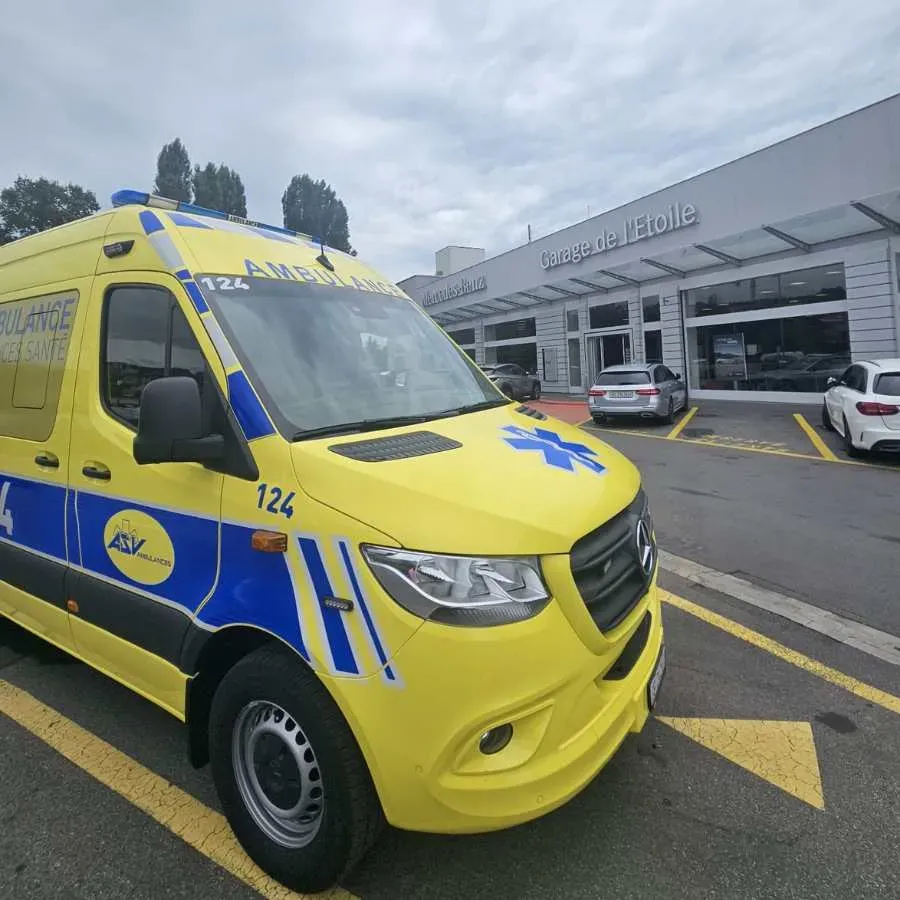
Emergency ambulance developed on a Mercedes-Benz Sprinter chassis. The requirement was for a vehicle capable of handling a high volume of calls without compromising ergonomics. The interior layout was designed to provide immediate access to essential equipment and easy movement around the stretcher, even while the vehicle was in motion. Each workstation was positioned with the teams that would be using it in mind.
- Converted van
Geneva — 2024
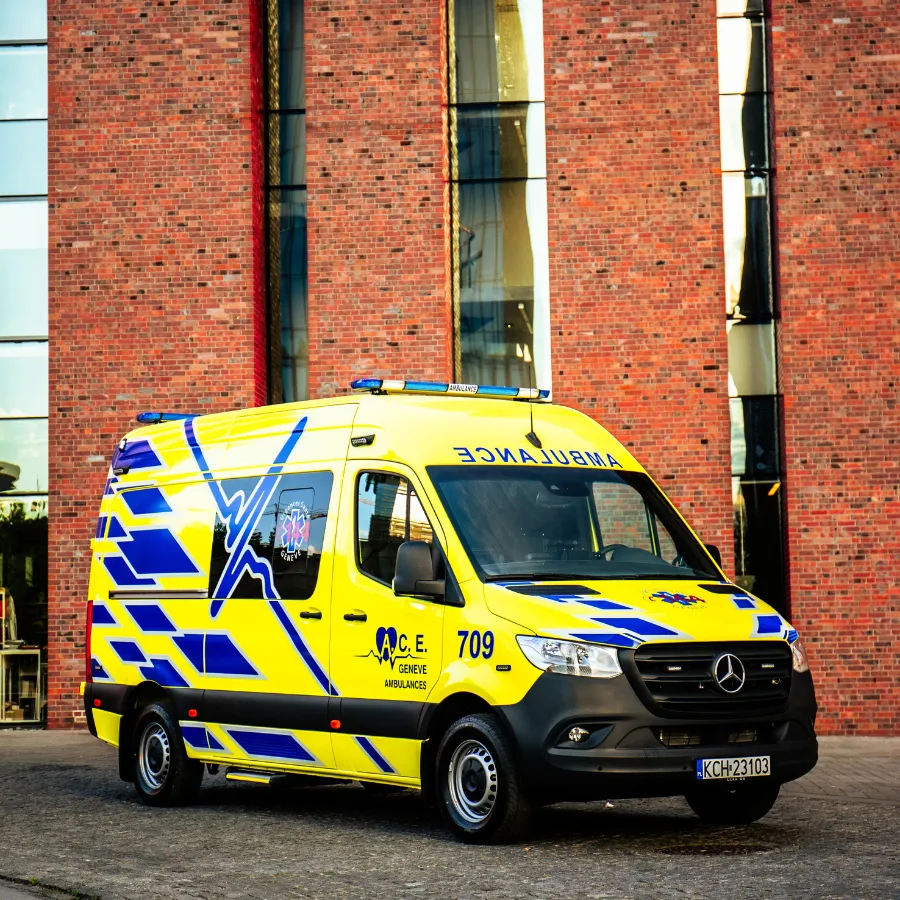
Two ambulance vans
Two custom-built van ambulances, produced in collaboration with Geraton. Ordering two identical vehicles imposes an additional requirement: reproducibility. Two ambulances from the same fleet must be rigorously interchangeable, so that a crew changing vehicles finds exactly the same setup.
- Subwoofer
BINZ Partnership
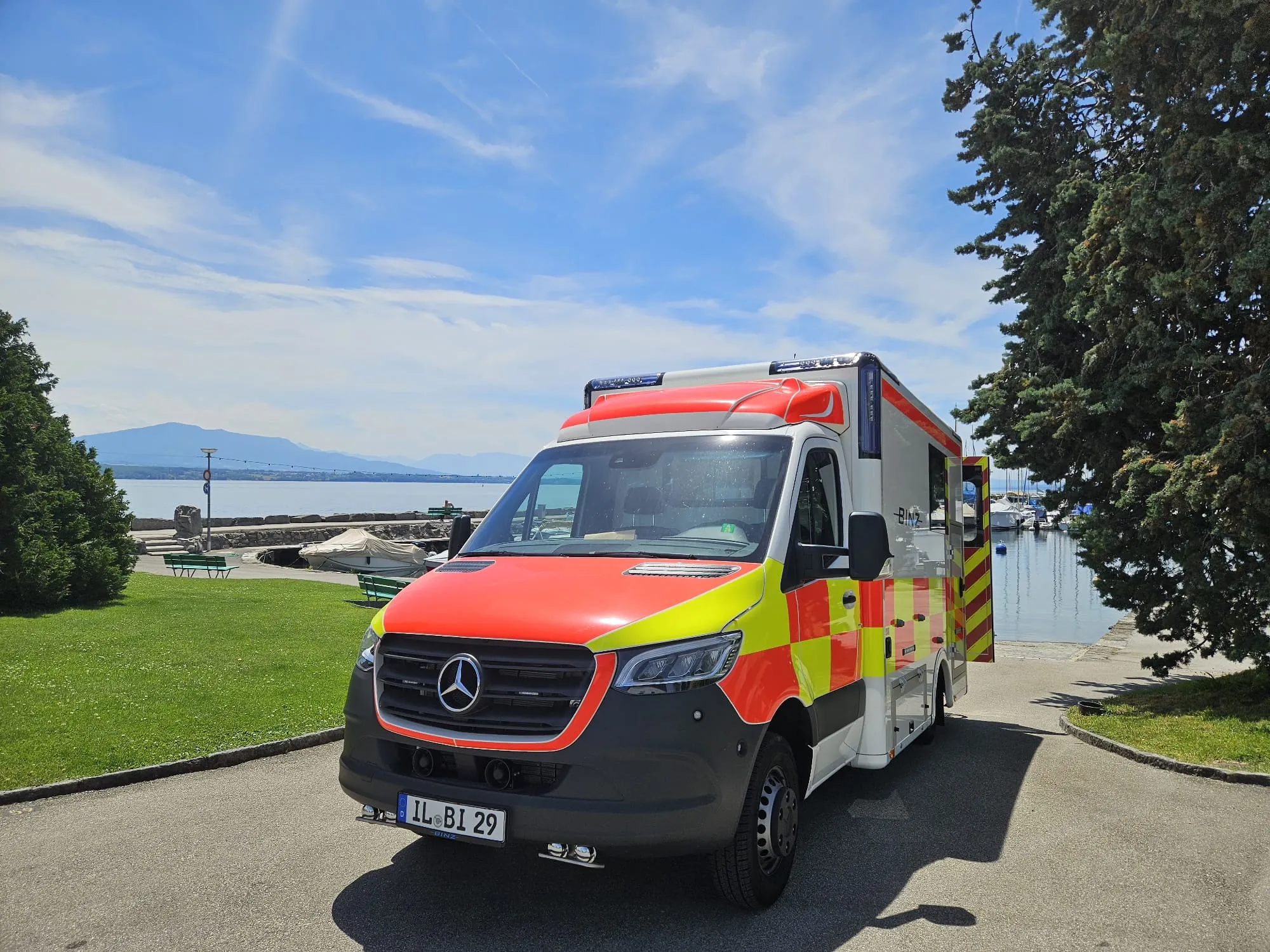
Ambulance box on a Mercedes-Benz chassis
This modular ambulance, developed in partnership with BINZ, showcases the advantages of this modular design: reinforced bodywork, advanced modularity, and optimized medical space. This configuration is recommended for operators with intensive fleet use who want the option of transferring the ambulance body to a new chassis.
- Specialized vehicle
BIOPARC Geneva
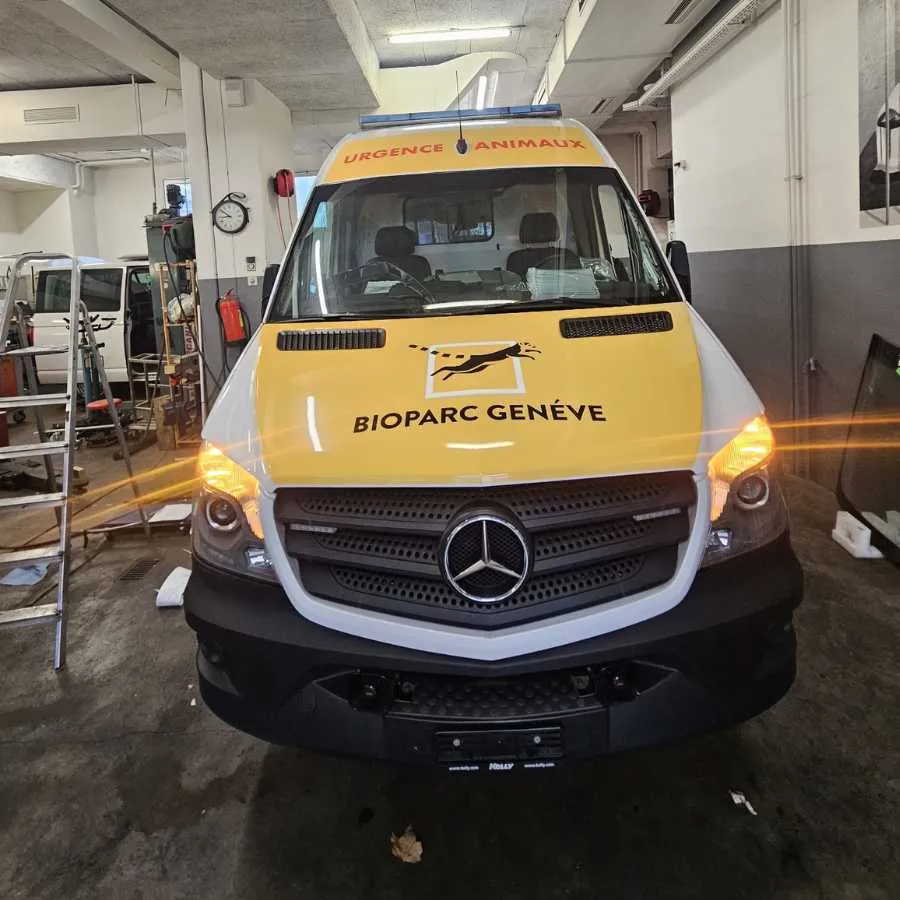
Veterinary ambulance
Custom-built veterinary ambulance based on a Mercedes-Benz Sprinter. The medical transport of animals presents challenges not found in human emergency response: dedicated compartments, appropriate immobilization and monitoring devices, and the handling of animals of widely varying sizes. The custom design approach extends far beyond the standard ambulance.
View the project - Reconditioning
Canton of Vaud — November 2025
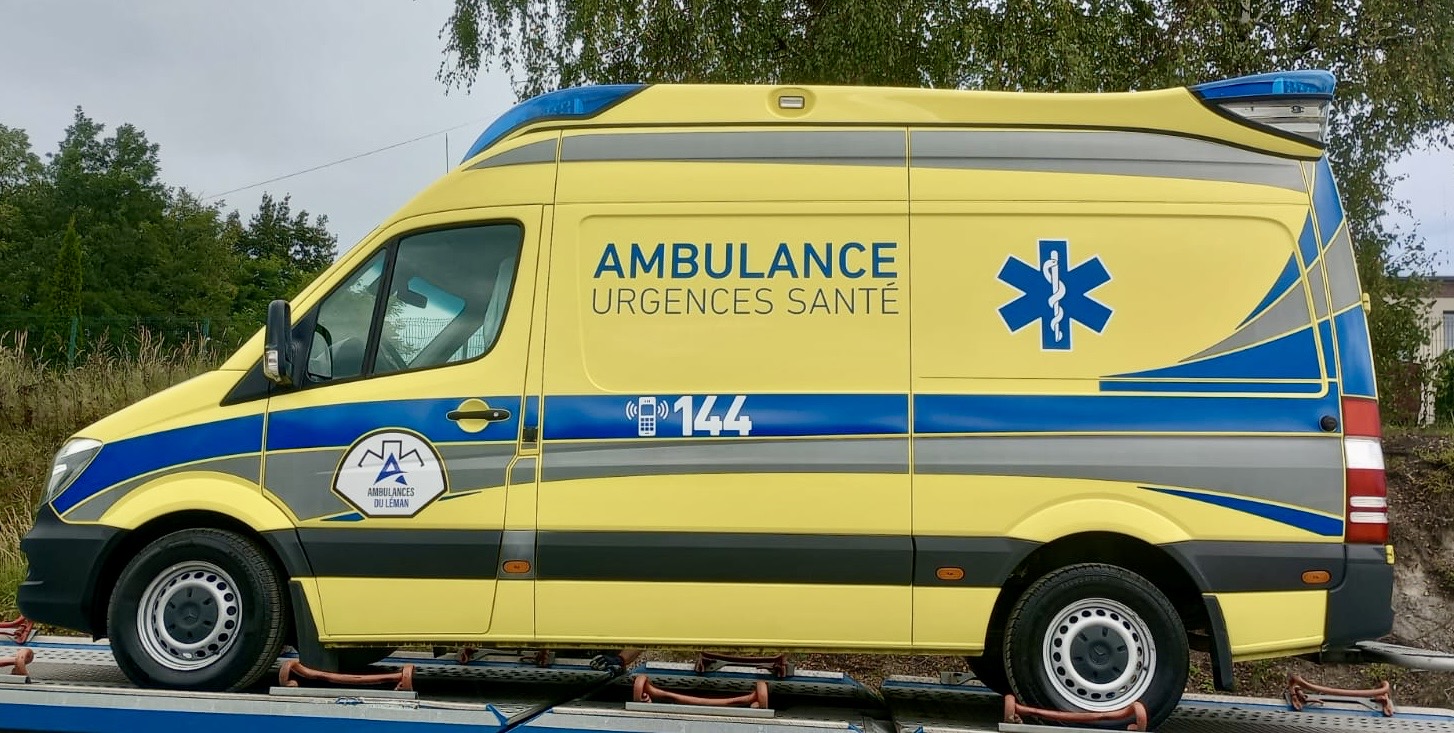
Refurbished used ambulance
Refurbished ambulance based on a Mercedes-Benz Sprinter. Every component has been inspected, upgraded, or replaced as needed, and the interior layout has been optimized for rapid response. A reliable and compliant vehicle, available without waiting for a new one.
View the project
Is there a project for an ambulance or medical vehicle that needs to be studied?
Request a free studyFrequently Asked Questions

How long should I expect to wait for a custom-made ambulance?
The lead time depends on two main factors: the availability of the chassis from the manufacturer and the inspection times of your canton's vehicle registration office. These two elements constitute the bulk of the schedule, far more so than workshop time. A conversion or reconditioning is significantly faster than a complete build, as it eliminates the wait for the chassis. We will provide you with a firm schedule along with the quote once the configuration is finalized, and we will keep you informed at every stage.
Can we convert an ambulance or a vehicle already in our fleet?
Yes, that's one of our three options. We start with a vehicle diagnostic: body condition, mileage, remaining payload, and available electrical capacity. This diagnostic determines what can be installed and whether the conversion is economically viable compared to a new build.
Which chassis base do you recommend?
We primarily work with the Mercedes-Benz Sprinter, due to its reliability, payload capacity, and extensive service network in Switzerland. Our partnership with the Pierre Steulet SA network gives us direct access to vehicle configurations and post-delivery technical support. Other vehicle bases are possible depending on your fleet requirements and existing agreements.
What factors influence the price of a custom-built ambulance?
Four elements account for the bulk of the budget. The formula chosen First, a complete construction, a transformation, and a reconditioning are not on the same order of magnitude. vehicle category Next: a type C, with its equipment and power supply requirements, has nothing to do with a type A. choice of box van or box van, which modifies both the manufacturing cost and the residual value. Finally, the’onboard medical equipment, This can represent a significant portion of the total cost depending on the integrated systems. We itemize each component separately in our quotes, so you can make an informed decision rather than relying on a single overall price.
Do you operate throughout Switzerland?
Yes. We are based in Geneva and deliver to all cantons, in French-speaking Switzerland, German-speaking Switzerland, and Ticino. The initial consultation can be conducted remotely or at your premises, according to your preference.
What happens after delivery?
Delivery includes a vehicle handover with your team and the provision of the technical documentation and certificates required for operation. For the chassis, our partnership with the Mercedes-Benz Pierre Steulet SA network gives you access to direct manufacturer support. For the interior fittings, we remain your point of contact: we designed the vehicle, we know every circuit and every fixing point, which significantly reduces diagnostic time should any work be required.
Let's talk about your project
Describe your tasks and constraints: we'll call you back for a free, no-obligation consultation. The more precise your request, the more helpful our initial response will be. If you prefer to discuss this further by phone, contact us directly.